

Duke Ellington 50 years on
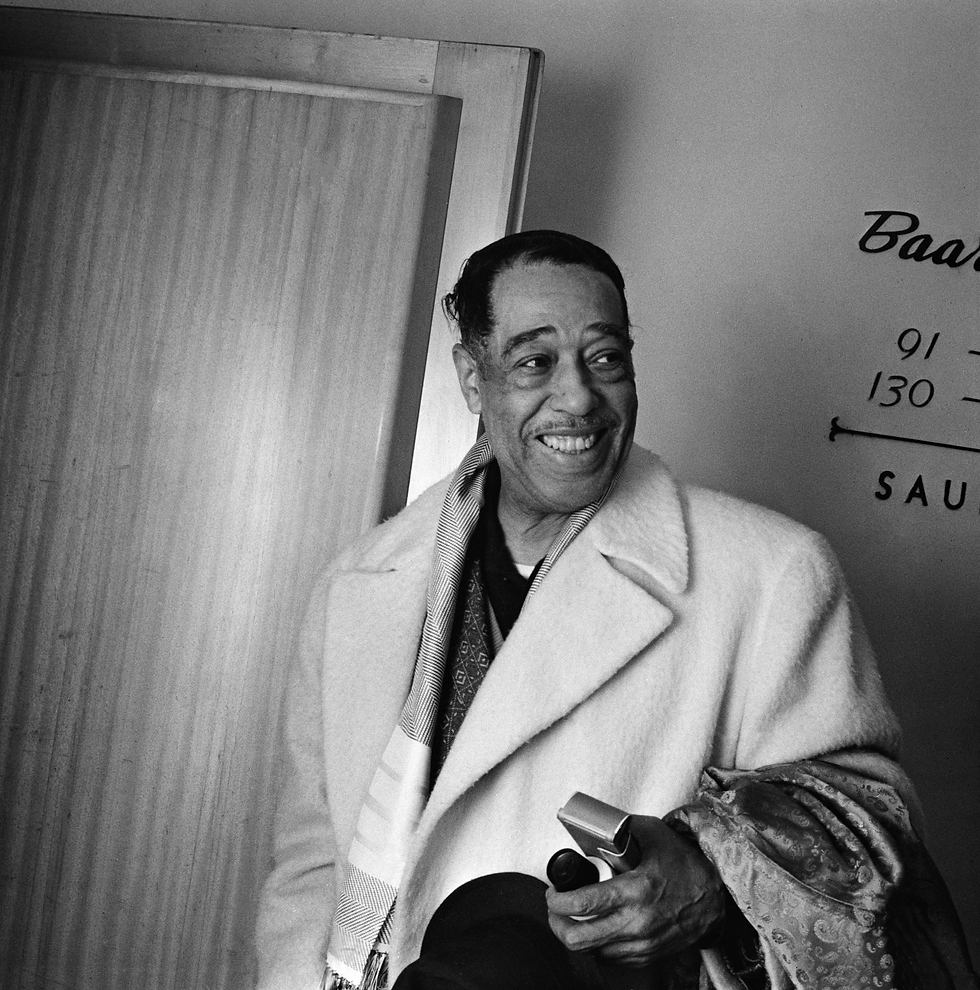
The word “genius” is perhaps rather too readily banded about in discussions about jazz these days. The group of musicians who indisputably deserve this title is actually quite small, but it must include Louis Armstrong, Lester Young, Charlie Parker and, of course, Duke Ellington. Trombonist ‘Tricky Sam’ Nanton wasn’t so sure however: 'Genius? I don’t know about that. But, Jesus, can he eat!’ Fifty years after Duke’s death his legacy as a composer and band leader remains an imposingly important one. His music is simply staggering in its quality, scope and sheer quantity. Miles Davis, a figure almost as mercurial as Ellington, recognised his brilliance, commenting shortly after the bandleader’s death: ‘All the musicians should get together one certain day and get down on their knees and thank Duke’.
Ellington was an enigmatic and complicated character whose musical self was multi-facetted. His oddly un-revealing biography ‘Music is My Mistress’ (published in the early 1970s) famously avoided telling us anything much of what lay beneath the face he presented to the public. Accordingly we must look to the words of others and his own more candid moments to reveal the true nature of his genius.
Firstly Ellington was a very practical musician and an astute business man who understood how to get the best out of his musicians. From the early 20’s he was booking out and playing in bands all over Boston and making forays to New York for gigs with bands like the now forgotten Wilbur Sweatman outfit. By 1924, at the age 25, he’d established himself as the leader of ‘The Washingtonians’ which already boasted the talents of trumpeter Bubber Miley, saxophonist Otto Hardwick and drummer Sonny Greer. He remained the leader of his own working band for the rest of his life until shortly before his passing, aged 75, in May 1974. By his own admission, he was a heavy drinker in those early days when he had a band of topers but was abstemious later on. Hats off to Otto Hardwick, who earned the nickname ‘Professor Booze’ even in this crapulous company.
The Duke Ellington Orchestra was like a large dysfunctional but brilliant family that rumbled around the world for forty years, leaving an indelible impression on all who heard it. His son Mercer described it thus: ‘Duke ran his business like a family and his family like a business.’ The leader had a tremendous tolerance for some of the wayward behaviour of his musicians. For example, Rex Stewart and Cat Anderson didn’t speak for 15 years despite being in the same same section; trombonist Lawrence Brown and the Duke only spoke at rehearsals; Tenorist Paul Gonsalves and Ellington enjoyed an almost father-son relationship despite the saxophonist’s debilitating addictions. It was a band that operated on mixture of forgiveness, the turning of many blind eyes and richly diverse individuality.
It’s modus operandi was unlike any other jazz orchestra. Often in later years the band would start a concert with several members not yet on the stage. Duke took all this in his stride because the opportunities it presented for a composer were unique and unprecidented. ‘I work and I write and that’s it,’ he once observed. ‘My reward is hearing what I’ve done and, unlike most composers, I can hear it immediately. That’s why I keep these expensive gentlemen with me.’ On another occasion he explained ‘There is nothing to keeping a band together. You simply have to have a gimmick, and the gimmick I use is to give them money.”
Saxophonist Ben Webster, key contributor to Ellington’s vaunted 1940-43 line-up commented: ‘When Duke gets ready for that band to play I still don’t know how he does it. He turns that band on like you’d turn that faucet on and the band plays. He’s an easy going man.. but he’s got a way to let you know let’s take care of business. He’s so slick, he doesn’t say ‘Do this’, ‘Do That’… That’s why there’s only one Ellington.’
Although he often declared that the orchestra was his ‘instrument’, Duke himself was an outstanding piano player. Initially inspired by the James P Johnson stride school, his playing soon broadened out into a percussive, rhythmically daring style full of instantly recognisable dissonant chords and utilising the whole span of the keyboard. Later modernists like Thelonious Monk and even avant-gardist Cecil Taylor incorporated a lot of Ellington into their approaches. Duke’s trio recordings ‘Piano Reflections’ in 1953 and, in particular, the 1962 collaboration with Charles Mingus and Max Roach ‘Money Jungle’ give a good illustration of the sheer breadth of his playing.
Duke always wrote for specific voices within his orchestra. In the ‘Swing Era’, contemporaneous bands such as Count Basie’s were dependant on riffs and soloists (Lester Young, Dickie Wells, Harry Edison and Buck Clayton), but none were specifically written for in the bespoke way the musicians were in the Ellington band. Even in the orchestra’s ensemble passages, individual voices were always readily identifiable. Harry Carney for instance was always discernible on baritone and later still Jimmy Hamilton’s clarinet was often featured as an internal colour within the sax section. In Ellington’s world the solo voice remained at the heart of his band’s expression. Compare, for example, Basie’s ‘Lester Leaps In’ with the Duke’s ‘Cottontail’,recorded within months of each other during the early war years, to hear a their differing distinctive methods at framing a soloist.
The Ellington band was always more organic. When a new member joined, the band got larger and new members were often required to find their own ensemble parts. Both Ben Webster and cornetist Rex Stewart experienced this and created their own contributions by ear. This was an abiding part of the Ellington folklore. I always took these stories with a pinch of salt until Harold Ashby, arguably the last great soloist in the band, joined the Humphrey Lyttelton band for a concert and did just this, adding a spontaneous fifth part to the Ducal arrangements. And if a musician departed the band, Ellington always welcomed fresh contributors.
Duke once said ‘There is no such thing as a replacement in my band. A new musician means for us a new sound.’
Throughout his career Ellington delighted in writing for all these unique sounding voices: ‘You can’t write music right unless you know how the man that’ll play it plays poker.’
Instinctively he knew a musician’s potential. He once maintained that if a player only used ’20% of his horn’, their particular skill-set would provide something utterly personal to at a specific point. ‘The wise musicians are those who play what they can master.’, he believed and there are myriad examples throughout the Ellington discography. Indeed there remains a convincing argument that players well known for their Ellington stints rarely played as effectively elsewhere.
In fact many ex-Ellingtonians- Johnny Hodges, Ben Webster, Cat Anderson et al.-retained their former boss’s compositions at the core of their working repertoire, as if knowing they had already found their perfect niche.
If there is one device which characterises Ellington’s writing from the earliest days, through his classic period and up until his final works, it was his belief in the vocalised capabilities of his sidemen, able to turn trumpets, trombones and saxophones into personal approximations of the human voice.
An early Ellington stalwart the trumpeter Bubber Miley was a subtle master of the plunger mute as was trombonist Joe ‘Tricky Sam’ Nanton and this ‘Jungle’ style permeated each successive edition of the band, most notably in the growling playing of Cootie Williams. Another key sideman from Ellington’s 1930’s/40’s orchestra, the clarinetist Barney Bigard noted of this genius: ‘Duke studied all his men. He studied their style, how they manoeuvre with their playing and he keeps that in mind, so if he wrote anything for you it fit like a glove and you’re really at home playing it’.
This ability to craft new music around a band of frequently shifting personnel gave each of Ellington’s many line-ups their own distinct character.
As one of the most collaborative band leaders in jazz as well as it’s most self-sufficient composer, from 1939 to 1967 Ellington’s genius was augmented by that of the man he once described as ‘my right arm’. pianist/arranger Billy Strayhorn, whose compositional ambitions matched that of his musical ‘employer’. Theirs was a complicated, symbiotic relationship. Nick-named ‘Sweet-Pea’, Strayhorn seemed almost telepathic in his musical compatibility, Ellington calling him ‘the eyes in the back of my head… my brain waves [are] in his head and his in mine.’
Strayhorn was credited with the classic compositions Lush Life, Take The A train, Chelsea Bridge and Raincheck but others like Satin Doll, which bear all his hall-marks were often credited solely to Ellington. There is no doubt that Strayhorn composed with full understanding of the Ellington style but sometimes his partner’s comment ‘Strayhorn does most of the work, but I take the bows’ must have rankled, especially when much of the composing work on suites such as ‘Such Sweet Thunder’ had been tactfully delegated to him.
When Strayhorn died in 1967 the orchestra recorded a whole album of his compositions released under the title ‘And His Mother called him Bill’ including ‘Blood Count’ his final piece, a perfect ballad vehicle for the unusually anguished tone of Johnny Hodges. In many ways this recording says farewell to the richest era of Ellington’s music
So how to sum up Duke Ellington, a musician whose body of work across a career of fifty years encompassed every form from the blues to ballet, show tunes to extended suites, informal improvised settings to Hollywood movie scores? I can think of no better quote than this from pianist and composer Andre Previn who, in the early 1950’s said: ‘Stan Kenton can stand in front of a thousand fiddles and a thousand brass and make a dramatic gesture and every studio arranger can nod his head and say”Oh yes, that’s done like this.” But Duke merely lifts his finger, 3 horns make a sound and I don’t know what it is.’
Today, half a century after his death, Ellington the man remains something of an enigma. Yet his music contains the perfect mix of majesty, mystery and indelible melody that is the very life blood of jazz.


When it comes to introducing music through listening and practice, I would rather understand one useful detail properly than rush through a long list of ideas. Listening for one musical detail can make a short piece feel entirely different. That connection helps me see why ok rummy can be worth a closer look. A short discussion of an everyday example would make this easier for me to connect with, especially as someone still learning about the subject. Which listening exercises work well before a learner starts studying notation?
I can see why planning a thoughtful visit to Fethiye would invite discussion, since different people will bring different experiences to the same question. Leaving space between activities can make a travel itinerary easier to enjoy. It gives me a more concrete starting point for thinking about yonogames. I am still thinking through the details, and a small example would help me picture how this works in practice. How would you balance sightseeing with time to explore without a schedule?
https://casinoohneoasis.me is where my mind wandered when you mentioned the band operating on forgiveness and blind eyes, because any group that survives four decades together runs on that same unspoken ledger. Reading about Rex Stewart and Cat Anderson not speaking for 15 years while still sharing a section made me think of every office I've worked in, where the work somehow gets done despite the grudges. Mercer's line about running the business like a family and the family like a business says more about leadership than most management books I've read.
Sau khi thấy một số người chia sẻ, mình cũng vào 8xbet xem qua để tham khảo cách họ làm giao diện và chia chuyên mục. Cảm nhận ban đầu là trang web trình bày rất mạch lạc, bố cục cân đối và chia khu vực rõ ràng nên nhìn rất thoáng mắt. Mình cũng để ý việc di chuyển giữa các mục khá thuận tiện nhờ thanh điều hướng được bố trí rõ ràng. được thiết lập với các chuyên mục riêng biệt, tạo cảm giác dễ tìm kiếm thông tin nên người mới cũng không mất nhiều thời gian để làm quen.
La información sobre Magis TV descargar me pareció clara y útil para una primera consulta. Quienes están considerando una instalación pueden revisar previamente los requisitos y la compatibilidad. Además, conviene comprobar la fuente de descarga y revisar el archivo antes de utilizarlo.